A calmer way to inspect a messy music library.
NyxCore scans my local collection, surfaces duplicates and metadata problems, and turns them into a review queue I can actually reason about.
The important part is not finding more problems. It is seeing the evidence and the proposed operation before a real file changes.
- Role
- Product design + engineering
- Stack
- React · FastAPI · Python
- Environment
- Local music library
- Principle
- Review before write
WHY I STARTED IT
My music library had become a mix of ripped CDs, downloads and old transfers. Tags were all over the place, duplicates had piled up, and I couldn’t tell what was actually worth fixing.
I wanted to eventually use track details like BPM to make better playlists. But before asking NyxCore to make suggestions, I needed a clear picture of what was already in my library—and a chance to review every change.
Metadata gaps
Missing artists, albums, artwork and track information.
Exact duplicates
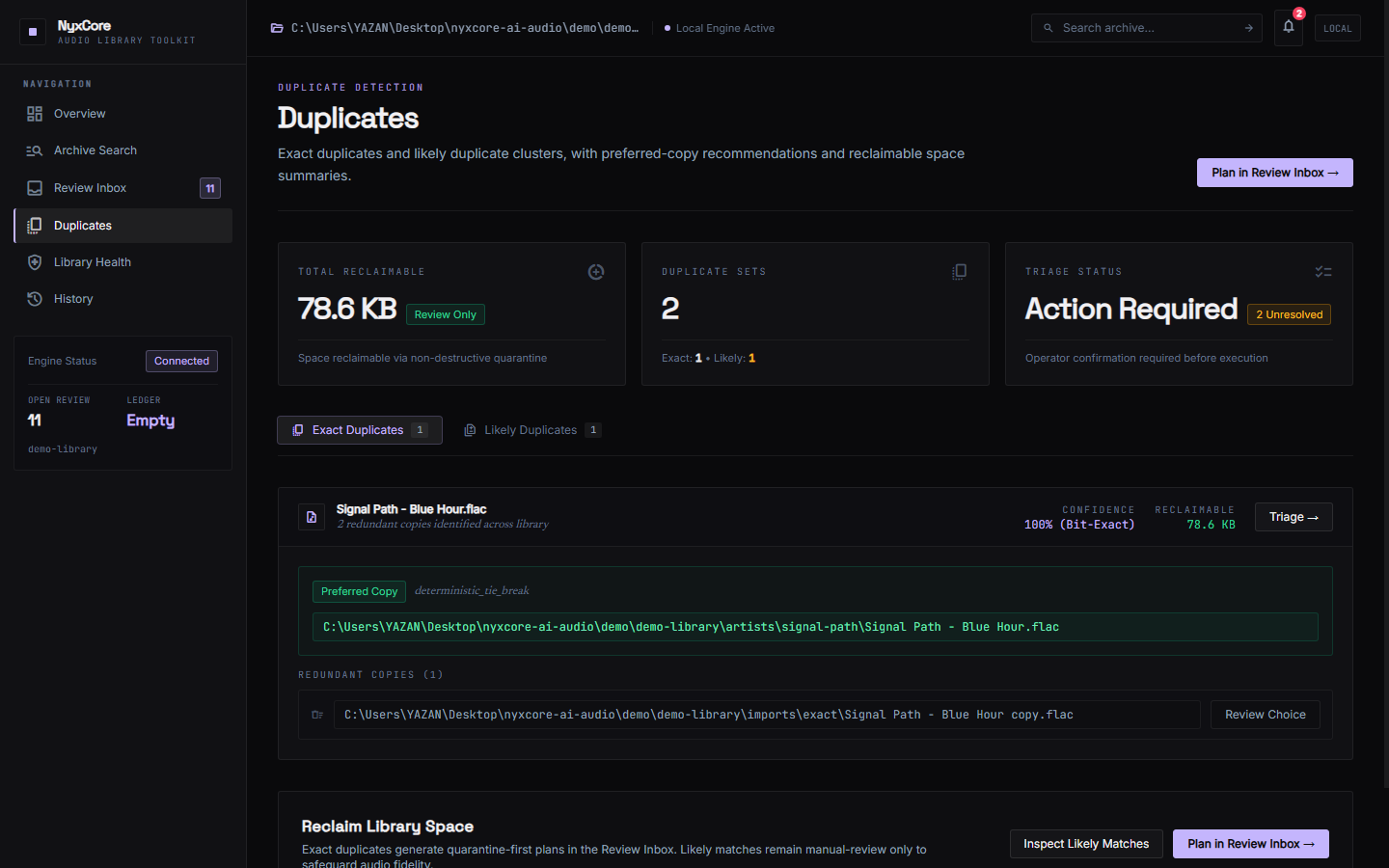
Identical audio can still arrive with different names or tags.
Likely matches
Similarity is useful evidence, not permission to delete.
Real files
Every decision eventually touches a collection I care about.
WHAT IT DOES RIGHT NOW
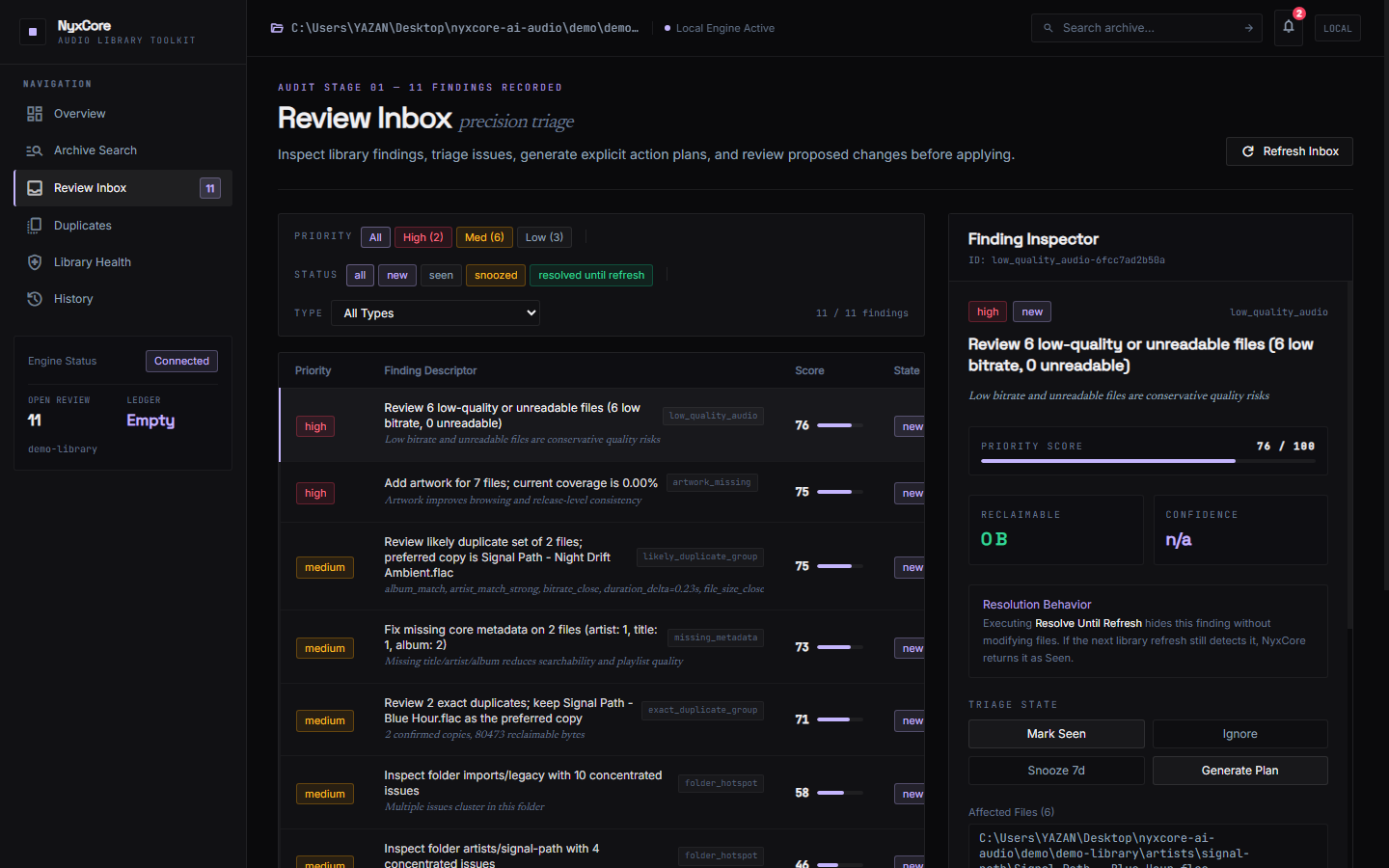
Right now, NyxCore scans my local music library and brings possible problems into one review inbox. I can open a finding, check the evidence, and decide what to do before anything changes.
Review before action
A finding stays visible beside its evidence and available decision. Nothing is silently converted into a write operation.
Certainty stays visible
Exact copies and heuristic matches are not presented as the same kind of truth.
The whole collection remains legible
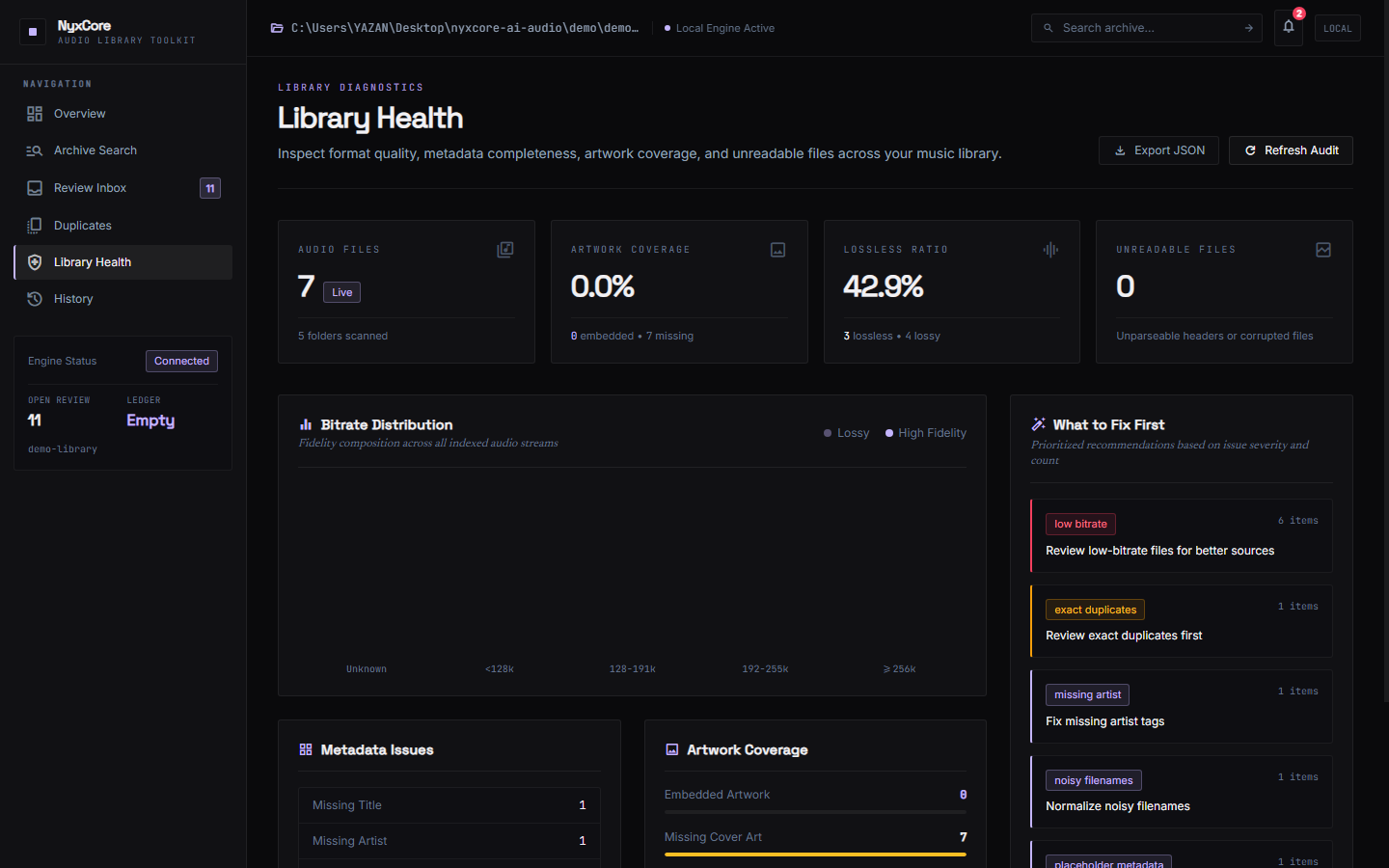
Health signals reveal where attention is needed without pretending that every anomaly should be fixed automatically.
The product follows one visible signal path: scan the collection, inspect the finding, review the proposed operation, then decide whether it should happen.
See the collection
Library Health makes missing metadata, artwork gaps and suspicious values visible across the collection.
Understand the finding
The Review Inbox keeps the issue and its evidence together so the next decision is informed.
Approve an explicit plan
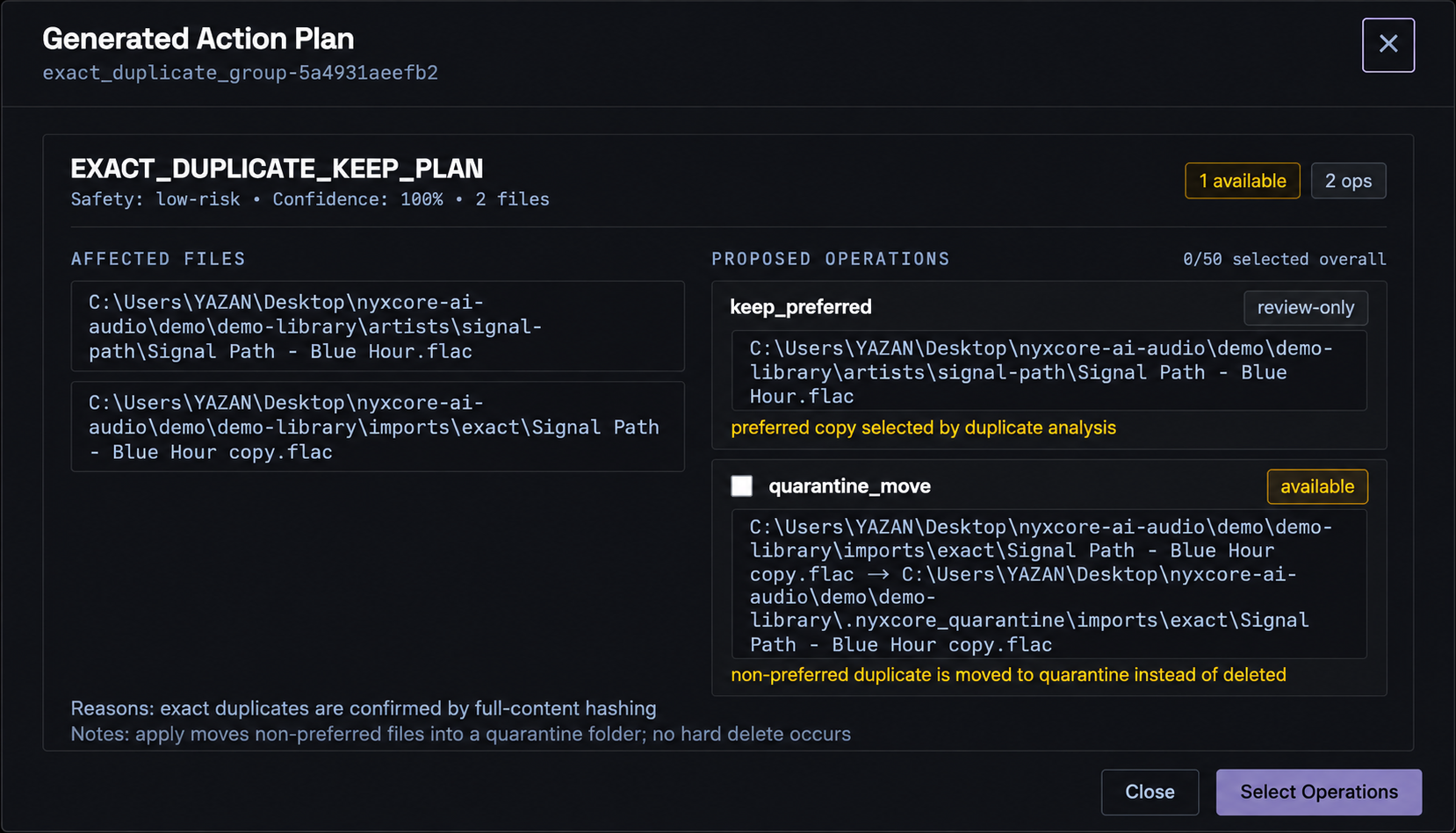
Selected actions become a readable plan. Duplicate copies move to quarantine instead of being destroyed.
See the collection
Library Health makes missing metadata, artwork gaps and suspicious values visible across the collection.
NyxCore Library Health diagnostics for a local music collectionUnderstand the finding
The Review Inbox keeps the issue and its evidence together so the next decision is informed.
NyxCore Review Inbox with a selected finding and evidence panelApprove an explicit plan
Selected actions become a readable plan. Duplicate copies move to quarantine instead of being destroyed.
NyxCore action-plan dialog listing proposed operations before executionWHY I WAS CAREFUL WITH CHANGES
Supported review actions become plans that record file fingerprints and the relevant paths or metadata changes. Findings without a safe action stay out of apply. Applying a plan uses a single-writer lock and journal; duplicate copies move to quarantine instead of being deleted.
Before reversing a supported operation, NyxCore checks the file again. If it no longer matches the recorded fingerprint, that operation is refused and the file is left untouched. An error is recorded while other operations may continue.
Explicit plan
The proposed operations are inspectable before execution.
Fail-closed checks
Changed or stale files are not treated as the files that were reviewed.
Quarantine first
Supported duplicate removal keeps a recoverable path instead of hard-deleting.
Recorded outcome
The ledger preserves what was attempted, applied, refused or failed.
Keep the loop small. Make the judgment better.
v0.3.0 is a foundation, not a finished platform. The next work is about making the existing review loop more useful before expanding what NyxCore promises.
Clean the library
Improve the review queue for duplicates and obvious metadata problems.
Suggest better metadata
Use more track and collection context while keeping approval explicit.
Build useful playlists
Explore BPM and other verified track information without weakening the core safety model.
A small tool I can trust with my own library.
v0.3.0 gives me a working path from a scan result to an action I have reviewed and recorded. It is still experimental, but the core loop is real—and it gives me something useful to build on.
- 142
- Backend tests
- 12
- Frontend tests
- Local
- Library boundary
- v0.3.0
- Experimental release